
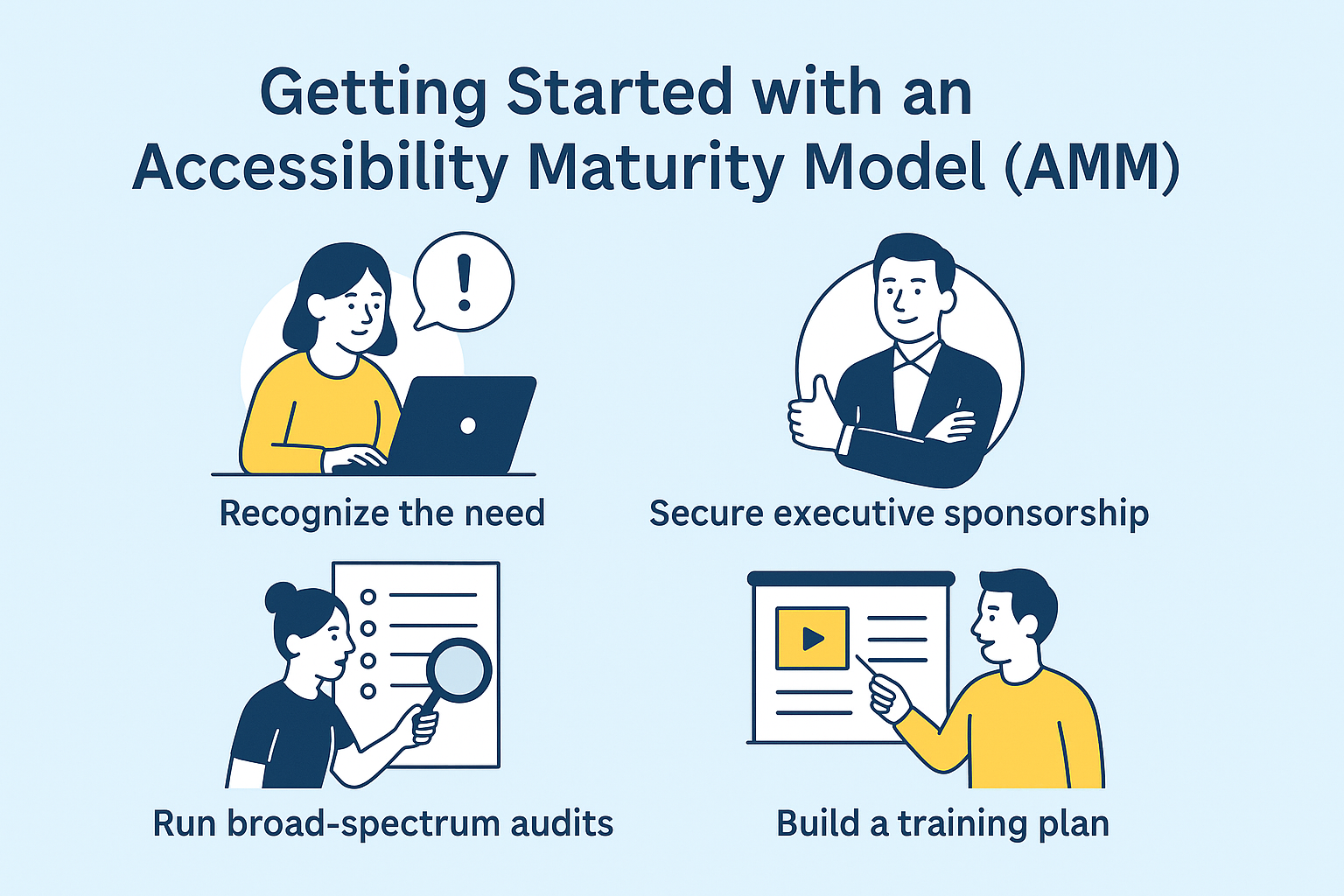
Digital accessibility isn’t a one-time project; it’s an organizational capability that grows stronger with sustained focus. An accessibility maturity model (AMM) offers a clear, staged path from first awareness to full integration, and the World Wide Web Consortium’s Accessibility Maturity Model is now the most widely referenced framework. The guide below is meant to spark thinking about whether an AMM is right for your organization and how to begin.
What is an Accessibility Maturity Model (AMM)?
At its simplest, an AMM is a structured framework that maps the journey an organization takes as it embeds digital accessibility into its culture, processes and products. It describes a series of clearly defined stages, often labelled anything from Initial or Ad Hoc through to Strategic or Optimized. In doing so, you can see exactly where you are today, what “better” looks like, and which capabilities you must develop to reach the next level.
Recognize the need and begin
Most organizations first come to accessibility through risk avoidance or customer complaints, but a self-assessment against the AMM quickly reveals broader benefits: larger market reach, stronger brand trust, and better talent retention. Completing even a “level 0” baseline shows where gaps exist and provides the data you need to justify budget and staffing. The important thing is to start. The model is designed to work whether you are a five-person start-up or a multi-division enterprise organization.
Secure executive sponsorship
Progress stalls without a visible champion who can approve resources and remove roadblocks. The AMM’s Culture dimension stresses that sustained success hinges on leadership commitment; appointing a manager or director as sponsor signals that accessibility is a strategic priority, not an after-hours side project.
Run broad-spectrum audits
Early audits should look beyond public webpages to include documents, mobile and desktop apps, customer emails, and intranet tools. A professional audit uncovers WCAG issues across all digital touch-points and provides a remediation roadmap. While automated scanning tools can support ongoing monitoring, they’re most effective once your team has built a foundational understanding of accessibility principles and common issues.
Build a training plan
Training is a foundational pillar of any accessibility program. Once your initial audit identifies gaps, a structured training plan ensures that your team has the knowledge and confidence to address them. Start by providing role-specific training tailored to designers, developers, content creators, QA testers, and project managers. Each team interacts with accessibility differently, so targeted learning is more effective than one-size-fits-all sessions.
Up-skill continuously
Establish a continuous learning strategy to deepen accessibility expertise across your organization. Start by offering structured, role-based training through online video courses, which are both flexible and scalable. Many platforms provide curated learning paths and certifications on key topics such as WCAG guidelines, accessible UX design, semantic HTML, ARIA roles, and assistive technologies. These courses can be self-paced or integrated into your learning management system (LMS) for easy tracking and reporting.
To keep accessibility top-of-mind, implement annual recertification programs. These regular touchpoints reinforce best practices, keep teams up to date with evolving standards (such as WCAG 2.2 and forthcoming WCAG 3.0), and boost confidence in delivering inclusive digital experiences. Including practical exercises or scenario-based assessments helps maintain relevance and engagement.
Over time, this ongoing investment in training not only builds technical competence but also cultivates a culture where accessibility is embedded from the start, and not added as an afterthought.
Write an organizational accessibility policy
A formal policy turns intentions into requirements. Templates and guidance from accessibility specialists outline essential sections: commitment statement, scope, roles, standards, procurement language, and timelines. Publishing the policy internally gives every team the same north-star.
Iterate, measure, repeat
The AMM emphasizes incremental movement: set targets, implement fixes, reassess, and climb to the next level. Each cycle tightens feedback loops and embeds accessibility deeper into day-to-day delivery.
Stay the course
Culture changes require hard work and take time. Formal reviews alone can take weeks and may need multiple champions across geographies or business units. Expect uneven progress, celebrate small wins, and keep re-running the model; the W3C reminds us that “digital accessibility is a journey,” not a destination.
Practical first steps
Getting started with an Accessibility Maturity Model (AMM) doesn’t require a massive overhaul on day one. In fact, the most effective programs begin with a few well-chosen actions that build momentum and create internal alignment. Below are five practical steps your organization can take in the first month to lay a strong foundation:
- Download the W3C’s Accessibility Maturity Model spreadsheet and conduct a quick internal workshop to evaluate where your organization currently stands across key areas like culture, procurement, training, and product development. This exercise helps highlight immediate gaps and priorities.
- Identify a sponsor or leader with enough influence to advocate for accessibility at the strategic level. A sponsor plays a critical role in securing resources, guiding policy, and setting expectations across departments.
- Commission an accessibility audit. An audit conducted by qualified experts will reveal critical issues and offer a remediation roadmap that informs your early actions.
- Begin enrolling key teams (such as design, development, content, and QA) with foundational accessibility training. Online courses or vendor-led sessions can quickly raise awareness and competence.
- Summarize your organization’s intent in a one page outline. Even a rough draft provides a focal point for alignment and discussion, and signals to your teams that accessibility is becoming a shared priority.
By pairing honest self-assessment with visible leadership and iterative action, you lay the groundwork for steady, measurable progress and ensure that accessibility becomes an integral part of your organization’s DNA.